Submitted by Mary Marks, Wild Ones Appalachian Foothills Member and OSU Master Gardener Volunteer
Mid-summer is the time when Buttonbush begins to blossom in Ohio, something I eagerly anticipate. Even from a distance of more than six feet, I can hear the buzzing of bees and other pollinators covering the blossoms.
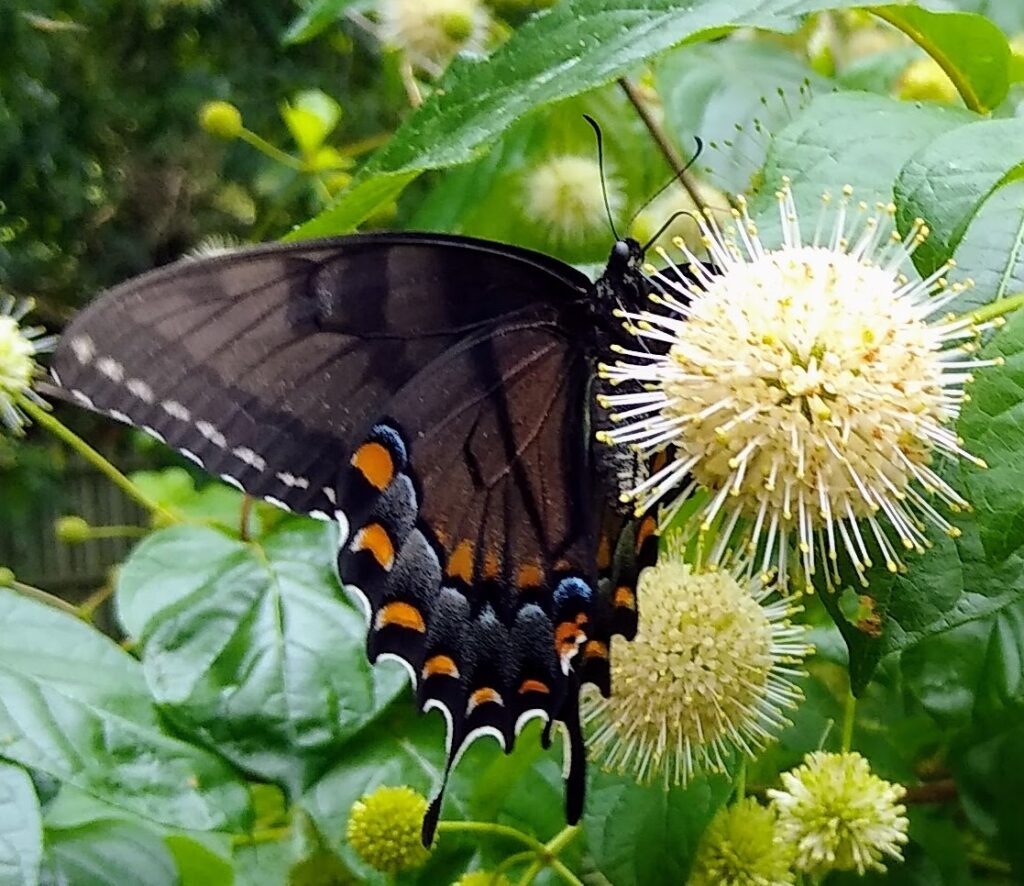
Skippers, monarchs and most any other butterflies are drawn to this unique plant; hummingbirds find its nectar irresistible. According to the Xerces Society, buttonbush is also host to large, showy moths including the Titan Sphinx, Hydrangea Sphinx and Royal Walnut Moth.
Buttonbush (Celphalanthus occidentalis), also known as Button Willow, Honey Bells, or Honeyballs is a North American native plant that can be found from Nova Scotia to Ontario, south to Florida, and west to the Great Plains. Smaller populations may be found in New Mexico, Arizona, California and northern Mexico.
In Ohio, it may be found in wetland areas, around pond margins, and in soil that is permanently moist according to the Ohio Department of Natural Resources. This bush or small tree with wide, sprawling branches can grow to about 7 feet tall and 15 feet wide; the trunk is often twisted. The shiny opposite leaves are elliptical and branch to the ground.
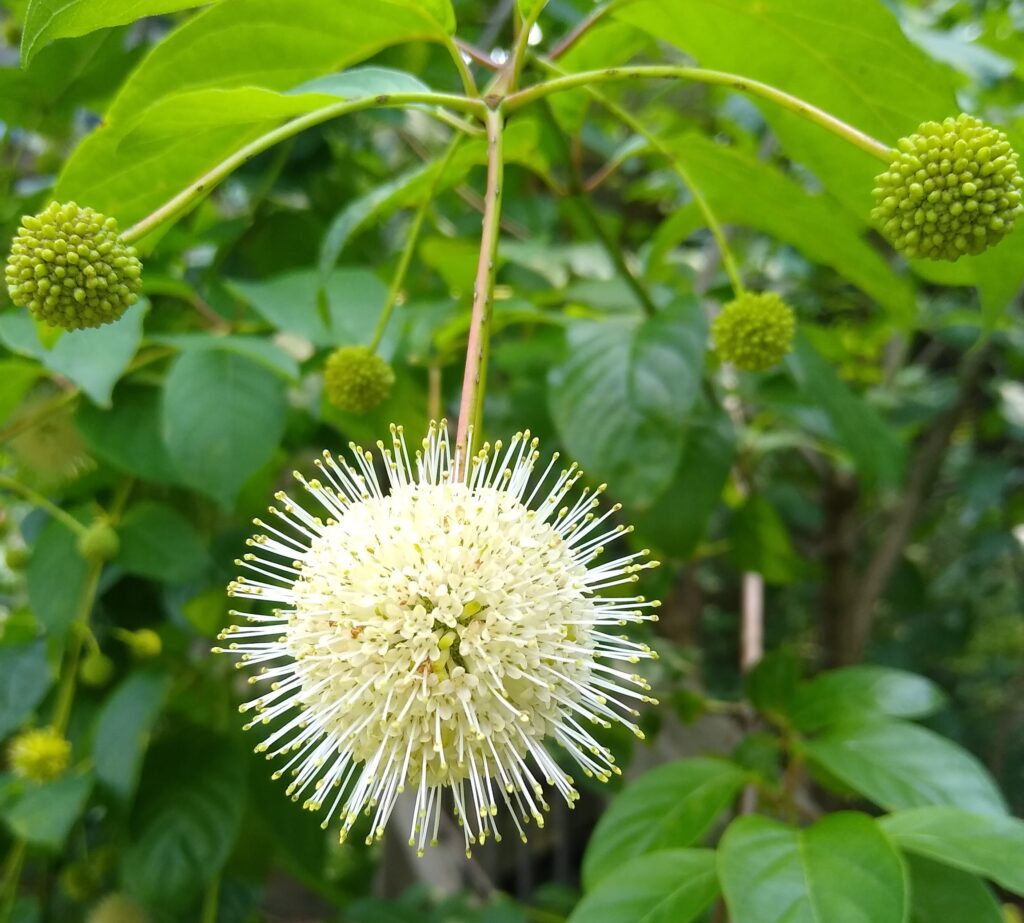
However, it is the flowers that are most striking. The flowers are white and spherical with needle-like styles, often described as having a “pincushion” appearance; they tend to grow in clusters. “Sputnik” is an apt nickname for the blossom. After the plant finishes blooming, “button like” seed heads form, leading to the common name for this plant. The fruit is initially knobby and green before changing to brown or black during winter.
Buttonbush is a wetland shrub with natural habitats such as swamps, floodplains, marshes and bogs or places that are underwater for part of the year. Therefore, this plant is often used for erosion control in wet areas or boggy areas with poor drainage. Buttonbush can tolerate heavy pruning that should be done in the dormant season or early spring before new growth starts. It lacks problems in terms of insects or disease and grows well in moist soils with various pH levels in full to partial sunlight.
Overall, buttonbush is a valuable plant for pollinator nectar production as well as ecological restoration. My first buttonbush began as a winter sowing project and was planted in a sunny area with permanently moist soil where it has thrived. Despite my concerns after a hard, late frost this year, it has rebounded well and once again produced those curious and beneficial blossoms.