
By Mary Marks, OSU Master Gardener Volunteer and Appalachian Foothills member
One of the joys of summer is the emergence of fireflies or lightning bugs. As night falls, watching the blinking, flashing, glowing insects may bring back memories of catching fireflies in jars during our childhood. However, like many insects the number of fireflies seems to be decreasing due to changes in and loss of habitat because of human activity in addition to climate change.
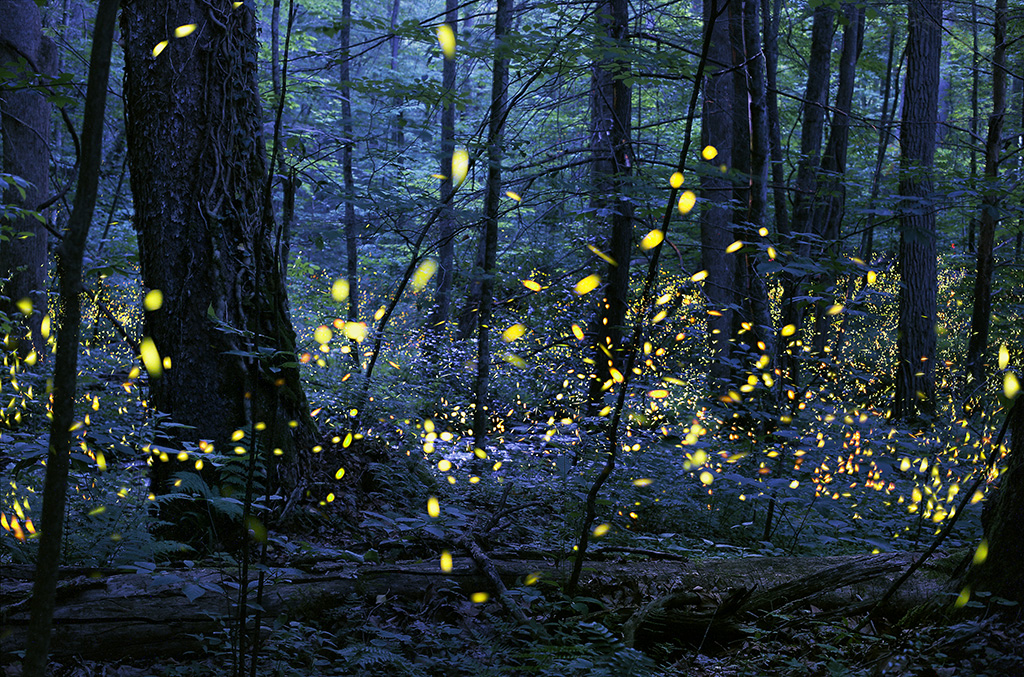
Fireflies are a type of common soft bodied beetle – not a fly or a bug. There are 2200 species throughout the world, 165-200 species in North America and 24 species in Ohio mostly active from June to August . There are three types of
fireflies: flashing, daytime darks and glow worms. The daytime dark type flies around during the day and does not flash. The flashing type can be crepuscular meaning they are active at dusk or nocturnal meaning they are active after dark.
The ability of a firefly to glow is known as bioluminescence. The abdomen found in the rear of a firefly’s three sectioned body contains a lantern that emits the glow which is actually a chemical reaction creating the flashing light we see. The firefly’s flashing is a mating ritual as well as a form of self defense by warning any potential predators of its bad taste. Some firefly eggs even glow.
Each species of fireflies has a characteristic light display. Some display synchronous flashes meaning they flash in unison; each spring the Great Smoky National Park holds a lottery for viewing the spring synchronous fireflies. https://www.nps.gov/grsm/learn/nature/fireflies.htm According to the Arc of Appalachia parts of Ohio also have synchronous fireflies that may be seen during “The Little Smokies Firefly Watching Workshop” scheduled for June 19 – 21, 2026 at Tremper Mound Preserve in Portsmouth, Ohio.
During the flickering courtship ritual, the male firefly flies about and flashes while the female – resting on tall vegetation or the ground – watches for the light pattern of her species. When attracted by the light sequence of the male, the female will flash back. Light signals are exchanged until the male goes to the female.
Fireflies use the ground, soil and leaf litter throughout their four stage life cycle – egg, larva, pupa and adult. Eggs laid on moist soil or leaf litter hatch after about three weeks. For the next one to two years fireflies in the larval stage consume snails, slugs, aphids, caterpillars, and cutworms – a beneficial type of pest management for gardens. Then they pupate underground or in rotting logs until they emerge as adults. The adults live only about two to three weeks before the female lays eggs.
As fireflies are attracted to moist environments, their number seems to be affected by drier conditions. Wooded areas support fireflies; some fireflies are attracted to tall grasses as they rest on long blades of grass or shrubs while others prefer the moist ground environment found in gardens and yards.
Steps that homeowners can take to support fireflies in their home landscape:
- Mow lawns to a height of 3.5 or 4 inches.
- Avoid or reduce use of pesticides or insecticides.
- Reduce and turn off outdoor lighting – flood lights, landscaping lights,pool lights, porch lights – because lights prevent fireflies from seeing other’s flashes necessary for communicating, finding mates and defending territory.
- Use amber bulbs with a yellow/orange hue for any essential lighting.
- Plant native plants, grasses and shrubs that support fireflies such as milkweed, Little Bluestem grass and Pennsylvania sedge.
- Leave leaf litter and mulch around plants.
- Avoid using lawn fertilizer.
- Leave overhanging branches on trees and bushes.