
By Mary Marks, OSU Master Gardener Volunteer and Appalachian Foothills member
A spring trip to Arizona once coincided with a spectacular desert spring bloom of wildflowers following a rainy winter. Seeing a landscape of cacti – saguaro, barrel, staghorn cholla, and prickly pear – covered in blossoms was a magnificent and hard to describe sight. Since prickly pear cactus seemed to be a unique yet common plant in the deserts of southwestern states, imagine my surprise upon finding this cactus during a hike at Salt Fork State Park. Wait a minute! What is that doing here?
The Eastern Prickly Pear Cactus (Opuntia humifusa), native only to the Americas, grows in USDA zones 4 – 9 and has the largest range of any cactus in the United States – from New Mexico and Montana east to Massachusetts and Florida. In Ohio it is most commonly found in the sandy dunes and savannas of northwestern Ohio or in rocky fields in some southern counties including Washington County. The state of Ohio has listed this cactus as a potentially threatened plant.
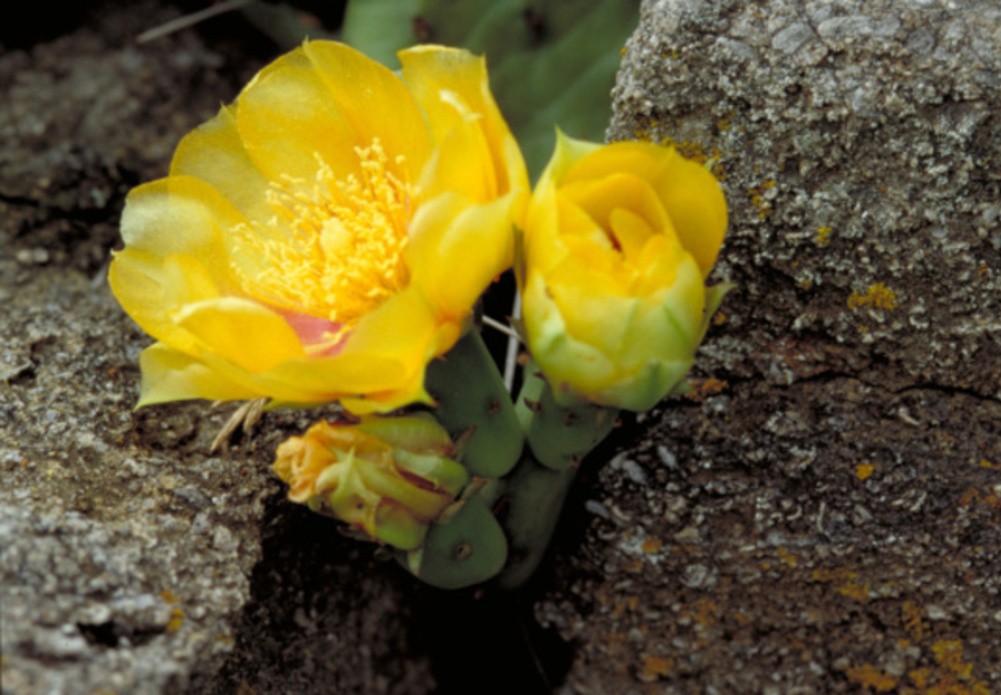
In Ohio, Prickly Pear Cactus blooms in early summer; each blossom lasts one day and blooms continue throughout the month of June. The bright yellow blooms are 2 – 3 inches wide with many petals around the mass of stamens; some blossoms have an inner ring of orange. The fruit that follows is a fleshy edible green sphere that ripens to red or purple and persists on the stem giving winter interest. Descriptions of the growth pattern indicate the plant will sprawl along the ground and grow up to 19 inches high. It has fleshy pads (pencas) that grow on top of one another; these pads are covered in defensive barbed bristles (glochids). During winter, the plant appears to deflate although it perks up as the weather warms. According to the US Forest Service, it survives midwestern and northern winters by storing water in combination with antifreeze chemicals in its cells.
During the blooming phase native bees, including bumblebees, Carpenter bees, leaf-cutting bees and others, are drawn to the pollen covered stamens of the cactus blooms. Other native pollinators for this plant are ants, wasps, beetles, and moths; it is a host plant for several moth caterpillars and fly larvae. Because of its bristles, this plant is understandably rabbit and deer resistant.
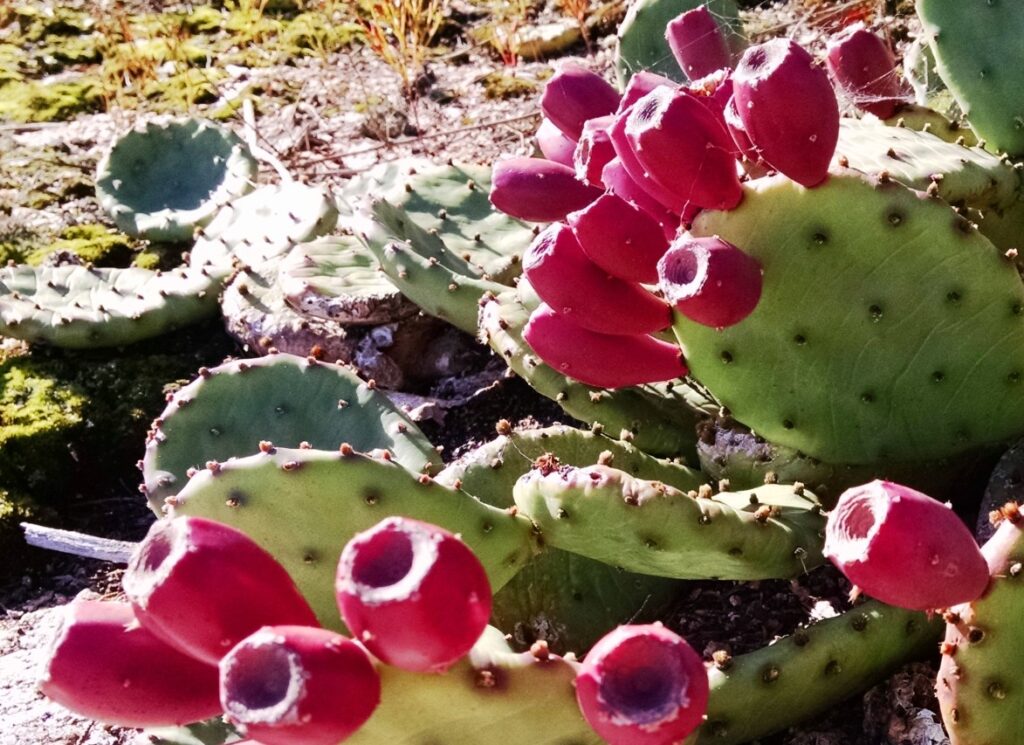
This edible plant is also sometimes used for making dye and medicines. The red fruit may be eaten raw after removing the skin or the fruit may be used for making jellies and candies. Some folks somehow snack on the fleshy pads of the plant. Medicinal uses range from a remedy for diarrhea to a treatment for diabetes. According to Purdue University the dye for the redcoats of the British Army and the Canadian Royal Mounted Police was produced from a particular insect that thrives on prickly pear cactus.
Photo: Shaun Roche, Public Domain, https://www.fws.gov/media/prickly-pear-cactus-red-purple-fruits-outer-islandjpg
If you want to include this native plant in your garden, keep in mind it is a cactus that requires full sun and well drained soil. Consider growing it in a rock garden or along a stone wall; some articles suggest growing the Eastern Prickly Pear Cactus in a container as it may become difficult to control. It can be grown from seeds or cuttings. Wearing long sleeves and gloves when weeding or working around the plants is advised because of the nearly invisible barbed bristles that can get into the skin and cause irritation.